
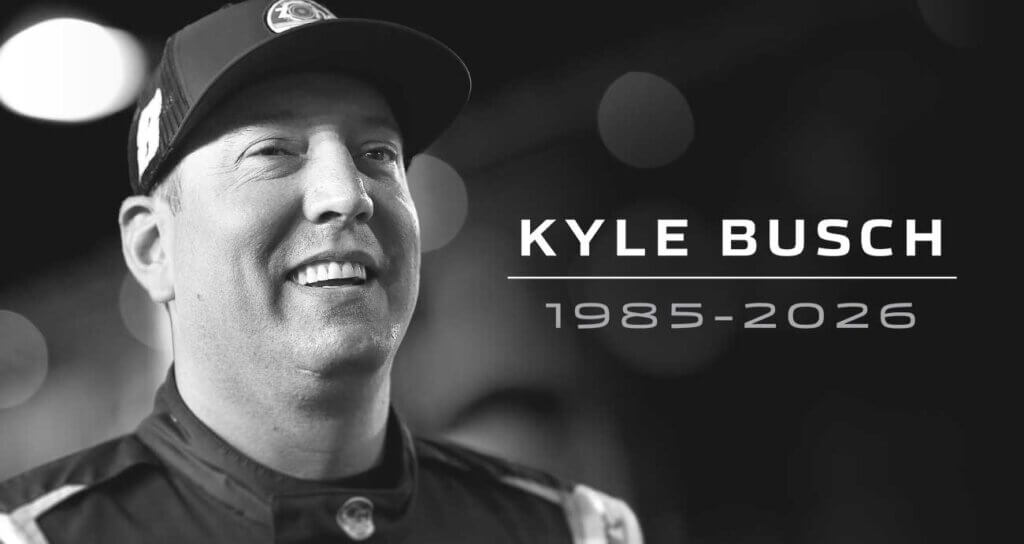
It’s been an unbelievably sad year in racing. We’ve lost motorsports legends, childhood icons, people that we’ve mythologized our whole lives for what they could do in a race car. Not since 2000 or 1993 have we lost so many so soon.
Michael Annett. Greg Biffle. Alex Zanardi. All gone in the last year. And now, we’ve also lost Kyle Busch.
Busch, 41, was hospitalized with a “severe illness” Thursday morning, announced by Richard Childress Racing, who said that he would be out of the #8 this weekend, in addition to his other ride with Spire Motorsports’ #7 in the Craftsman Truck Series.
Just hours later, his passing was announced. He is NASCAR’s first active driver to lose his life since 2001.
It’s hard to put into words what Kyle Busch meant to the motorsports world. He was a transcendental figure. He could go on the Pat McAfee Show one minute, and fight for the WWE 24/7 championship the next, all while racing week-in and week-out at NASCAR’s highest level, dabbling in the two “lower” series of competition and supporting his young son Brexton’s budding racing career.
He was NASCAR’s ultimate superlative; an extremely talented man of many nicknames. He was “Wild Thing” early in his career. “The Candy Man” while running the iconic M&M’s #18 for Joe Gibbs Racing. His trademark name in the end was “Rowdy”.
And boy, did he live up to it.
Legendary run-ins made him a villain in the sport to many fans, but also a hero to those who did support him. Feuds with Ron Hornaday, Dale Earnhardt Jr., Kevin Harvick, and Joey Logano (to name a few) made him as polarizing as he was talented.
There’s a famous Mike Joy quote from a 2007 run-in with his older brother, Kurt, that I always appreciated: “He has all the talent in the world, if only he could harness it.”
And harness it, he did.
Busch went on to become NASCAR’s winningest driver across all three national touring series, hitting 234 wins with a dominating performance at Dover just last weekend in the Craftsman Truck Series. He became a two-time Cup Series champion. A champion in what was then the Nationwide Series in 2009. He became an owner of one of the most successful Truck programs in history, winning many races and championships, and giving breakthrough opportunities to more drivers who are now at the sport’s top level than anyone else.
Kyle Busch did nearly everything you can do in this sport, and just last week, it felt like there was still so much more he was going to do.
There was still a Daytona 500 trophy to capture. It took Dale Earnhardt 20 tries to win NASCAR’s biggest race, and Kyle Busch had become the biggest sentimental favorite in the field, similar to Earnhardt before his victory in 1998. He was tantalizingly close so many times. He had the fastest car in 2009, only to be taken out in a late crash. A second-place in 2019, watching his teammate Denny Hamlin win it for J.D. Gibbs, who had passed away just weeks before. And then in 2023, when he was leading with his teammate Austin Dillon behind him at the 500-mile mark, but lost it in overtime.
All of these heartbreaking losses were supposed to end with a cathartic victory. What will now be his final Cup win at Gateway in 2023 was not supposed to be the end. He was a legendary driver, who deserved a legendary send-off when his time came, like Jimmie Johnson or Jeff Gordon or Tony Stewart. To see it end so suddenly and unexpectedly is surreal.There was still more to see and to do.
He was vocal about wanting to race with his son Brexton, who just turned 11 three days prior. He was a doting father and husband, who in recent years was willing to show more of that side of himself to the media and to the fans. He was still “Rowdy”, but he was also a family man who cared deeply about his loved ones and did incredible work behind the scenes to help others, especially through his and his wife’s charity, the Samantha and Kyle Busch Bundle of Joy Fund, who used their own experiences with infertility to help many couples start families of their own.
Racing and fate are often cruel and unfair mistresses, uncaring about status or deservedness. Talking with friends, the what-ifs were prevalent. What if he won another Cup race? What if he won the Daytona 500? What if he got to race Trucks with Brexton in the twilight of his career?
It’s the what-ifs for his family that I feel the worst for. Personally, I lost my mother to cancer in 2022, just after my 21st birthday. In the few years since, I’ve wondered many times what it would be like if she were here. What it would be like for her to have witnessed events in my life since she left this Earth. I cannot fathom what it would’ve been like to lose her a decade earlier in my life, or even sooner than that. It is a heartbreaking and unimaginably sad reality for his two children. There really aren’t words to describe it – it’s a void that no words can fill.
Kyle Busch was many things to many people, both in racing, and in life.
Hero or villain. Husband and father. He was an old-school legend or a reckless loudmouth. But no matter what you called him, he was always himself.
For me personally, there were more colorful nicknames in my house growing up that probably couldn’t be repeated here. As a kid, I resented his winning ways and his attitude both on and off the track. Even my own mother couldn’t stomach the idea of rooting for him. Truthfully, in my formative years, as was the case for many of my friends, I could not stand Kyle Busch as a driver, even if I thought he had some of the best paint schemes in the garage (an important metric for a young kid getting into racing).
But as time went on, I found myself pulling for him. The older I got, the more I respected his attitude and his driving style. The less he won, the more I rooted for him to go get another win.
At his core, Kyle Busch was what I aspired to be as a five-year-old kid who was getting into racing. A winner, a wheelman, a badass. Someone who was good to his fans, and also just as good at playing it up for those who couldn’t stand to see him win.
At 25, Kyle Busch is still what I aspire to be, but in different ways. The Kyle Busch of 2026 was still those things I listed before, (just look at the old-school ass-kicking he handed out to those Truck drivers in Dover if you need proof) but he was also a devoted family man, a good friend, and someone who was unafraid to be himself, whether the cameras were around or not. He was a savvy veteran that, while unafraid to still be “Rowdy” on the radio with his team or with competitors on the track, seemingly had the mature presence that he would’ve needed early in his career.
I haven’t felt a loss like this in racing in a long time. My personal memories flash back to losses in IndyCar with Dan Wheldon in 2011 and Justin Wilson in 2015. NASCAR last lost a badass icon in 2001, and a generation later, this feels eerily similar. It collectively feels like the world has stopped spinning, and that this is a bad dream that we are all surely hoping that we wake up from soon.
Much like when Dale Earnhardt died, the calls for number retirements and event postponements are coming in droves. And as Richard Childress Racing renumbers their #8 entry to the #33, even they acknowledge that the legacy of that number isn’t finished, setting it aside for Brexton Busch’s future NASCAR career. Austin Hill now steps into this seat in a position similar to what Kevin Harvick did in 2001, when his new #29 ran in place of the iconic #3 at the series’ next event in Rockingham.
Racing’s greatest day now sits under a heavy blanket of grief and sorrow. The tributes from not just the motorsports world, but the world at large, are almost overwhelming. It’s natural to wonder how we could even continue. But if you understood anything about Kyle Busch, you understood his love for competition, even through adversity. Whether it was age restrictions on competitors in the Trucks in 2001 when he arrived, or race limits for drivers in NASCAR’s two “minor league” series when he spent a decade making the lower ranks his personal playground, he was always finding ways to battle through adversity. It’s what drove him from a broken leg and a broken foot in a hospital room in Daytona Beach to the Cup Series championship stage in a 9-month span in 2015. It’s what made him NASCAR’s winningest driver ever in 2020, the year after he captured his second Cup title.
I would never want to speak for Kyle Busch, but I think, much like I think Dale would’ve thought, that he would want the show to go on, because racing is what he loved to do.
There is a daunting task in front of our sport, starting almost immediately, but the events of 2001 are proof that we can heal, that we can enjoy going to the track every weekend, and that we can lean on each other when times are hard, even if that process takes time.
This weekend is not going to feel good. NASCAR’s longest race is likely to feel like a 600-mile long vigil. This crown jewel may not have all of its usual sparkle, but we will race for those who are no longer with us, as we have before. We will come together and honor their memories every time we start those engines, because it’s the thing that not only we love, but the thing that they loved too.
This is a loss so seismic in scale that it may never heal for some. A quote from a friend of mine posted on social media simply said, “Superman isn’t supposed to die”.
I encourage everyone to share their love for Kyle, and to come together as a community to lift each other up, especially those who knew him and loved him.
There was a moment in 2022, when an engine failure knocked Kyle Busch out of an important race at Darlington. He went from leading to watching his title hopes drastically decrease in the blink of an eye. In an interview post-race with NBC Sports’ Kim Coon, he was asked how he was feeling after, and his response feels all the more relevant now:
“The sun will come up tomorrow.”
And while rain clouds so fittingly threaten this entire weekend’s slate of racing, I urge everyone to remember that even with this surreal, empty sadness that we feel, that the sun will shine on us all again someday soon.