
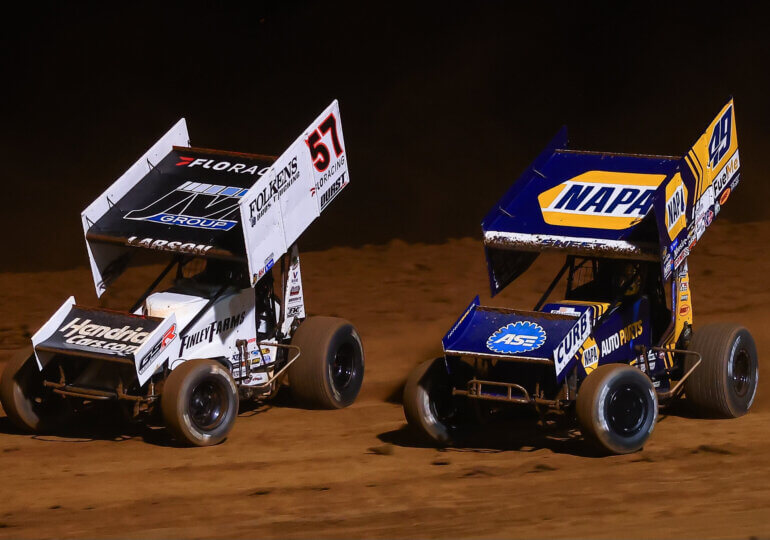
When Brad Sweet sought to create High Limit Racing, and over the most recent off-season turn it into a second, national sprint car tour, he knew that there would be an amount of criticism levied in his direction.
It’s to be expected, as the five-time World of Outlaws champion broke off from the series to launch the new tour with former NASCAR champion Kyle Larson.
The pair of storied drivers on dirt have captured nearly everyone’s eyeballs over the off-season, putting together a 60-race schedule and seeing 16 drivers already committed to race full-time with the series in 2024 – and that number is expected to grow even more before the start of the year.
“I mean, obviously, any time you’re doing a start-up business, it’s not easy,” Sweet said. “There’s a lot of challenges ahead, logistics and things that have to come together for it to all work. I think for the most part, any time you’re trying to do something new in our little niche world that we live in, to change status quo, I think some people are kind of questioning or upset about it. Obviously, we knew some of that would take place and that’s been tough, because we want to make such a positive influence for everybody.”
So how’d we get here and what’s to come?
***
High Limit certainly disrupted the status quo of the sprint car – and dirt racing – industry over the winter months, with the landmark announcement that was the creation of a charter system that the tour aims to fully implement by 2026.
The five, highest-finishing teams in the 2024 standings will be awarded a charter after the end of the inaugural national season. The next five, best-performing teams across the 2024 and 2025 seasons will take ownership in another set of five, original charters being handed out.
“Obviously, the charter thing is not meant to create any harm – it’s simply trying to give the owners some equity and some transparency,” Sweet said. “We’re hoping that as we build the streaming audience more and more, and there’s a higher demand, that we’ll be able to raise the rights fees from these streaming services – whether it be FloSports or whoever down the road. It’s all about demand and if we can work together as a group of however many car owners that it ends up being or whatever the resources make the most sense, the goal is simply to create a sustainable business model for car owners. Guys like me can’t go out and showcase our talent if we don’t get some more car owners (in the sport) and make this more of a sustainable business model for them.”
That’s been the pseudo-mission statement for the series – bringing a more sustainable, and unique, ownership model into the sport.
High Limit plans on doing so with the charter system and its 10 original charters, but it will also have the ability to give out more if everything goes according to plan.
What we’re trying to do is reward loyalty and performance – I think it’s important to – and that’s why we kind of laid it out the way we did over the course of two years,” Sweet said. “And I wasn’t sure how many cars would sign up.
“I think the biggest thing is High Limit wants to hold the option, so to speak, to add valuable or strategic charters down the road without diluting the race teams or the resources for the teams that already have charter,” Sweet said. “We’re just trying to figure out a way to have that option.”
The caveat to the want to add more charters will be attached by if its possible to do so without diluting the value of the others handed out over the next two winters.
“If it is bringing an immense value that is going to help the whole tide rise, then obviously that makes sense to give (another team) a charter,” Sweet said. “It’s hard to say exactly what scenarios are going to come our way, so we’re trying to leave ourselves some options – we want everyone to rise up together. If you look at how other major sports leagues are ran, even the worst teams still get their cut – their fair share – because there’s a balance between capitalism and socialism, so to speak, to where if you want the whole ship to rise up, everybody has to be healthy from top to bottom. And so (the charter system) is supposed to be somewhere in between where you’re rewarding performance, but the teams at the bottom are still able to compete and grow as well.”
Articulating that to teams was a big selling point, even though Sweet truly didn’t know how many would come to fruition.
“We haven’t set every rule in stone of how we’re going to lay the charters out, so we can always pivot a little bit if we feel like it’s in the best interest of the charters in the series,” Sweet said. “If we need to rethink exactly how it’s gonna lay out, we will, but we wanted to put it on paper to showcase where our minds are and showcase to those car owners that we want transparency and we want it to be a written contract, not just us saying that we want transparency.”
In totality, High Limit set up the new charter system with a plethora of paths that it could take in future years.
The only certainty is that there will be a spotlight on the race to the top five in points over the 60-race season.
“We’re not trying to put like block walls up and be like, ‘Hey, these are the only cars that can run with High Limit,” Sweet said. “So, there’s going be some sort of bonus point find and some sort of tow package that allows teams that might just be a year-to-year type and aren’t trying to run with a charter – we still want those teams to sign up and commit to our series. But, we ultimately want car owners that want to be doing this for 10, 15, or 20 years down the road, to build businesses and commit a lot to sprint car racing. We want them to be rewarded with us, because we are at the beginning. So if we do this together, and these short charters become very valuable, and that probably means the series is doing well – that means we’re winning together, and that’s very important to us.”
“So I agree with you with the top five getting those charters and securing those early on,” Sweet said. “This is all just new and starting. Nobody knows what this could look like three, five, or seven years out. Winning a charter this year could be worth way more money than anybody ever realizes down the road and obviously that’s a goal of ours.”
And that’s just one of the series’ goals.
There is an amount of moving parts that have all been buttoned together for 2024 in anticipation of the start of the series, but some of those will be un-buttoned before we know it, when talks for 2025 eventually start up this summer.
“I didn’t know what to anticipate team-wise,” Sweet said. “I read a lot of stuff out there that said, ‘there’s not enough teams to have two national series.’ But living in the world of sprint car racing as long as I have and knowing a lot of these team owners that were just kind of running a true outlaw schedule. I knew that if we put something together, that a lot of those teams would be able to find a home with High Limit. They didn’t necessarily want to sign up for (a full World of Outlaws season) because it’s a really grueling and really controlling (schedule) with not being able to run races outside of those events and (drivers and teams) have to run basically every weekend from February through all the way now into November.”
Sweet, and Larson, are being viewed as outlaws, but not one that represents the other side of the two-series national structure.
In the truest sense of the word, they’re going against the grain to make their vision a reality.
“I’ve had to compete for race wins and compete at the highest level for championships,” Sweet said. “Now, this is the next level of that and it’s business, it’s competing for racetracks to believe in what we’re doing. We all want to have the biggest events that High Limit can possibly have and we want to go to the best racetracks.”
That was another challenge in setting things up for the 2024 season.
High Limit made an extensive effort to race at Knoxville Raceway – the famed half-mile in Iowa that is home to one of the biggest races in the world in the Knoxville Nationals.
“It’s definitely disappointing that Knoxville went the route that they went,” Sweet said. “I thought it would be I guess, having an (ASCoC) race there (in the past), I didn’t see why it was so much different. But they had the reasons they chose this year. Hopefully, they’ll come back around, maybe after a year or two of Kind of seeing what we’re doing and what we’re capable of doing.”
But Sweet suspects that that wasn’t entirely by decision of the race track.
He said that when schedules were being put together, some tracks around the country were threatened by World Racing Group.
“It definitely took place,” Sweet said. “Tracks were definitely threatened – that they would lose their their races but ultimately, some tracks basically believed in what they’re doing and ultimately, they didn’t lose the races. So I think, if I was a track that didn’t book a High Limit race because they were told they would lose their (World of Outlaws) race, I’d certainly be looking at some of those other racetracks that got to host both and wonder why they were the exception in that rule.”
Six tracks appear on both the High Limit and World of Outlaws schedules for 2024, with the biggest name being Eldora Speedway, which split its four-day sprint car crown jewel weekend (Kings Royal) between two days for each series.
The other five tracks are Ohio’s Atomic Speedway, Arkansas’ Riverside International Speedway, Kansas’ 81 Speedway, and California’s Thunderbowl and Kings Speedway.
“We really wanted to be in some other markets,” Sweet said. “There’s a lot of politics, things that happened and threats. And I think for race tracks – it’s scary for them to lose a World of Outlaws event. So, when World Racing Group kind of threatens that they’ll lose a World of Outlaws race. I can’t really blame a track, if it’s been a successful event, to maybe not do a high limit event. I think, after some time -maybe a year or two – perception will change. And I think those tracks will feel more comfortable standing up for themselves and hosting High Limit events. They’ll be able to see what we’re capable of, what our driver lineup looks like, and obviously, the fans are going to want to want to see that type of entertainment.”
Sweet believes that moves like those he accuses of World Racing Group are more towards the short term.
“So like I said, I think it’s all new, I think some of those antics are short term plays, which is fine,” Sweet said. “Our vision is in front of us. We’re not really focused on any negative energy or things that didn’t go our way, or what World Racing Group is doing. We’re simply looking at the 60 races that we have on our schedule, the race teams that we have, trying to put the best team together and try to go out and execute at a high level and put on some great entertaining races for the race fans across the country.”
Nonetheless, in just over 30 days, the series will begin its journey in the national sprint car realm.
The challenges are far from over for High Limit and whether it wants to battle with World Racing Group or not, there won’t be anything to battle for if its product isn’t up to par.
“We knew there’d be some people that were maybe against it or have some negative input, but for the most part, I think everything has been kind of as expected, and (we’re) just very happy that we’ve gotten the feedback from the teams and so many people interested in joining the series, and kind of believing in what Kyle and I are trying to do,” Sweet said.
Sweet, Larson & co. will have to prove themselves.
But that’s nothing Sweet hasn’t done before.
“It’s motivating, right,” Sweet said. “My whole livelihood and career has been (filled with) people who’ve told me that I couldn’t become a professional racecar driver and I couldn’t become a champion. You know, this is kind of no different.